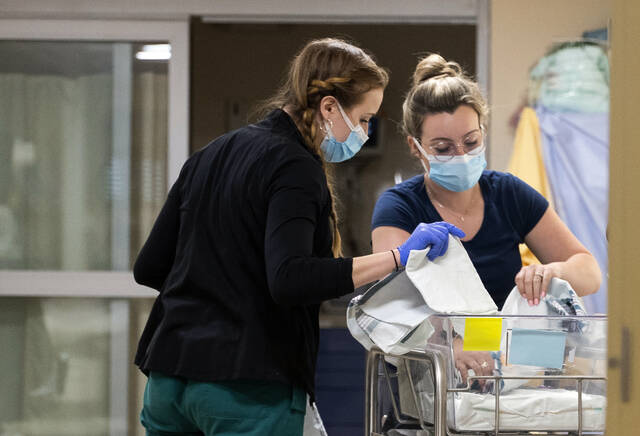
Babies born to opioid users had shorter hospital stays and needed less medication when their care emphasized parent involvement, skin-to-skin contact and a quiet environment, researchers reported Sunday.
Newborns were ready to go home about a week earlier compared to those getting standard care. Fewer received opioid medications to reduce withdrawal symptoms such as tremors and hard-to-soothe crying, about 20% compared to 52% of the standard-care babies.
Babies born to opioid users, including mothers in treatment with medications such as methadone, can develop withdrawal symptoms after exposure in the womb.
Typically, hospitals use a scoring system to decide which babies need medicine to ease withdrawal, which means treatment in newborn intensive care units.
“The mom is sitting there anxiously waiting for the score,” said the study’s lead author Dr. Leslie Young of the University of Vermont’s children’s hospital. “This would be really stressful for families.”
In the new approach — called Eat, Sleep, Console — nurses involve mothers as they evaluate together whether rocking, breastfeeding or swaddling can calm the baby, Young said. Medicine is an option, but the environment is considered too.
“Is the TV on in the room? Do we need to turn that off? Are the lights on? Do we need to turn those down?” Young said.
About 5,000 nurses were trained during the study, published Sunday by the New England Journal of Medicine.
Researchers studied the care of 1,300 newborns at 26 U.S. hospitals. Babies born before training were compared to babies born after.
The National Institutes of Health funded the work as part of an initiative to address the U.S. opioid addiction crisis.
“One of the great strengths of the study is its geographic diversity,” said Dr. Diana Bianchi, director of the branch that researches child health and human development. “We’ve had newborns enrolled from sites as varied as Sioux Falls, South Dakota; Kansas City, Missouri; and Spartanburg, South Carolina.”
Many U.S. hospitals have adopted the new approach, Bianchi said, adding she hopes the research will lead to recommendations from pediatrics groups.
Researchers followed the babies for three months and found no difference in urgent care or emergency room visits or hospitalizations — reassuring evidence about the safety of shorter hospital stays.
The new approach could yield “tremendous savings” in hospital resources, Young said, although the study didn’t estimate cost.
Researchers will follow the babies until age 2 to monitor their health.
Mothers want to be involved, Young said.
“For the first time, they feel like their role as a mom is valued and like they’re important,” she said. “We know that those first moments of a mom and a baby being together are really critical to bonding.”