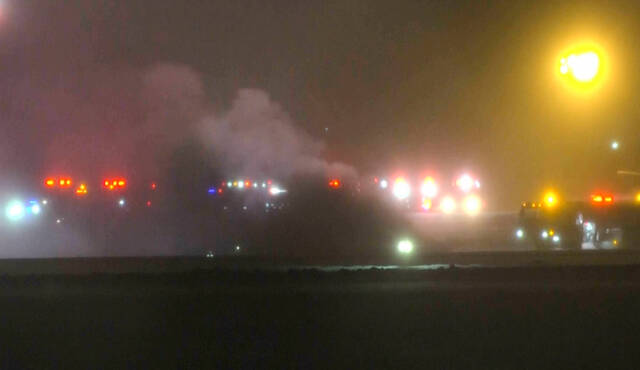
PORTLAND, Maine — Six people died when a business jet crashed during takeoff as a snowstorm moved in and visibility diminished in Maine Sunday night.
The Bombardier Challenger 600 flipped over and burned on takeoff at Bangor International Airport around 7:45 p.m. Sunday night as the nation’s massive winter storm was beginning to reach the area.
An audio recording of air traffic controllers posted by www.LiveATC.net includes someone saying “Aircraft upside down. We have a passenger aircraft upside down,” about 45 seconds after a plane was cleared for takeoff. First responders arrived less than a minute later, airport director Jose Saavedra said.
Experts say the weather and questions about whether ice accumulating on the wings kept the plane from getting airborne — as has happened at least twice before on that plane model — will likely be an initial focus by the National Transportation Safety Board. However, the agency will consider all possible factors.
“You can count on the fact that NTSB is going to look very closely at this,” said John Cox, who is CEO of Safety Operating Systems.
The airport said Monday afternoon there were six people aboard, according to the flight manifest, and all died. Earlier in the day, the Federal Aviation Administration had said seven died and one was injured but warned the numbers were subject to change, and the agency defers to local authorities.
Snowfall was heavy elsewhere at the time of the crash, but accumulation had just started in Bangor. Other planes had been taking off safely. But about half an hour before the crash, the pilot of a Florida-bound Allegiant plane radioed the tower to abort his takeoff.
“One, our deice fluid has failed and two, I don’t think the visibility is good enough for us to go, so we’re going to have to taxi back to the gate here,” the Allegiant pilot radioed. The controller responded by saying he was just getting ready to warn the pilot that visibility had dropped to about three-quarters of a mile.
At about the same time, the pilot of the Bombardier had taxied over to the deicing pad and was radioing in a request to get his plane’s wings and tail treated, according to audio posted by www.LiveATC.net. The plane remained at the deicing pad for about 20 minutes before taxiing to the runway.
The crash victims have not been officially identified
The identities of those onboard won’t be released publicly until they can be confirmed, officials said.
The jet was registered to a corporation that shares the same address in Houston, Texas as the personal injury law firm Arnold and Itkin Trial Lawyers, and one of the law firm’s founding partners is listed as the registered agent for the company that owns the plane.
The international airport in Bangor, about 200 miles north of Boston, is one of the closest in the U.S. to Europe and is often used to refuel private jets flying overseas.
FTA, NTSB investigators to examine wreckage
The airport, about 200 miles north of Boston, shut down after the crash and will remain closed at least until Wednesday so the FAA and National Transportation Safety Board investigators can examine and remove the wreckage.
No cause has been determined. The NTSB said preliminary information shows the plane crashed upon departure and experienced a post-crash fire, but that it would have no further statement until after investigators arrive in a day or two. The investigation will likely take more than a year.
An audio recording of air traffic controllers posted by www.LiveATC.net includes someone saying “Aircraft upside down. We have a passenger aircraft upside down,” about 45 seconds after a plane was cleared for takeoff. First responders arrived less than a minute later, airport director Jose Saavedra said.
Crash occurred as major storm hit New England
The airport’s longstanding joint use agreement with the Maine Air National Guard means “runways are ready rain or shine – or snow,” an airport website says, under the phrase: “A Little Snow Doesn’t Scare Us.”
The National Weather Service in Caribou, Maine, said the airport eventually received nearly 10 inches, but the snowfall was just beginning at the time of the crash, falling light but steady and accumulating just about a tenth of an inch between midnight and 7 p.m. Sunday. The service said wind speeds were about 10 mph, which is not out of the ordinary.
Other planes had been landing and departing around the time of the crash, Saavedra said.
“We have crews on site that respond to weather storms on a regular basis,” Saavedra said. “This is normal for us to respond to weather events.”
Jet has history of problems with ice
The Bombardier Challenger 600 is a wide-bodied business jet configured for nine to 11 passengers. It was launched in 1980 as the first private jet with a “walk-about cabin” and remains a popular charter option, according to aircharterservice.com.
The plane had just landed at Bangor from Houston at 6:09 p.m., according to FlightRadar24.com, so it would have likely been sitting outside in the snow for more than an hour before it tried to takeoff again. And it wouldn’t have taken long for ice to start building up on the wings — particularly if the plane was refueled with cold jet fuel that’s stored in wing tanks, a factor the NTSB has cited in previous crashes.
Airport officials said planes were being deiced at the airport at the time of the crash, but it wasn’t immediately clear when or if this particular plane was treated.
“Given the weather conditions at the time, and the history of wind contamination with this particular aircraft, I’m sure that’s something the NTSB is going to look into immediately,” Guzzetti said. “If there was any kind of precipitation at all, freezing precipitation, they would have needed to clean off those wings before they took off.”
Bombardier and the FAA recommended new procedures after the previous crashes to ensure these planes’ wings are free of ice, and Guzzetti said there have not been many crashes related to this problem in the last few years.